mnot’s Web log

Design depends largely on constraints.” — Charles Eames

Wednesday, 21 December 2005

Choosing a School in a Global Marketplace

Every parent should take a flip through the OECD’s Education at a Glance*, their annual look at the state of learning in most industrialised countries.

Why? First of all, it’s a wonderful way to cut through a lot of FUD and local politics when you’re trying to figure out how well your kids are being educated. While no statistics are perfect (or often even close), it’s a whole lot better to make measurable comparisons between systems than it is to base decisions on anecdotal evidence and speculation.

Secondly, In an age when global trade is booming, companies are winging their employees around the world, and more and more people are mobile across national boundaries, it becomes increasingly important to be able to make informed choices about what different countries have to offer. Part of that is figuring out if taking that transfer (or making that big lifestyle move) is going to do good or harm to your kids.

This year’s indicators are revealing.

For example, while US adults spend the largest number of years in school (indicator A1), our students score quite poorly in math (A4) and problem solving (A5), sometimes dramatically so. This isn’t just because there are some really bad schools along with good schools in the US; the variation of scores between schools in the US is below average (A6). That’s not to say that the US isn’t putting its money where its mouth is; no country except Switzerland spends more per student than the US (B1), and our teachers’ salaries are reasonably in line with others’ (D3).
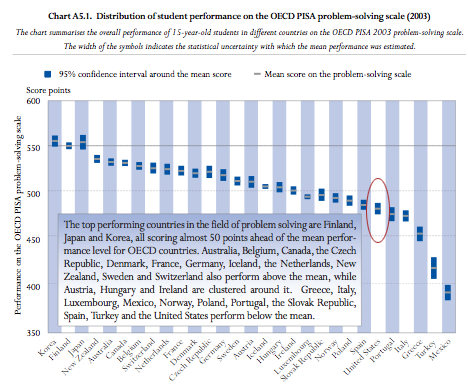
A5

In my eyes, the most interesting — and damning — data regards how many contact hours teachers have (D4). Most OECD countries have lower secondary teachers (for example) spend about 600 to 700 hours a year in front of students, giving them the rest of the time to work on lesson plans, grading and so forth. US teachers, however, have more than 1,100 contact hours a year. It’s not that we have a longer school year or longer periods of instruction; it’s that we’re working our teachers to the bone, forcing them to do their non-contact work on their own time.
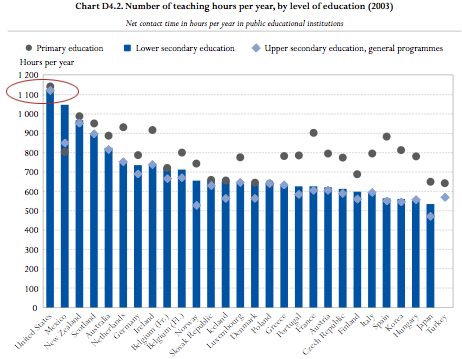
D4

But what about the effect of education? If your child completes tertiary education in the US, they’ll go on to make, on average, nearly 200% of what they would have if they’d stopped after upper secondary education (A9). In other countries (except Hungary), it’s no nearly so dramatic; I have to wonder if this is because the US rewards achievement more, or if it’s just because the quality of education before the tertiary level is poorer here.

On another track, it’s interesting to see the increased numbers of foreign students in Australian universities over the last few years (C3); I’m not sure what the effects on the quality of education will be there long-term, but it’s been controversial in the short term.

Finally, the section comparing public and private schools (D5) is fascinating; once you balance for socio-economic factors, US public schools actually have an advantage over private ones, at least in mathematics.

Take all of this with a grain of salt; I haven’t read every word in the report (it’s over 400 dense pages long), and I’m just a layman. I’d love to see discussion and further interpretation of the results.

* Note that you can get a limited-time trial account at SourceOECD, which will allow you to download publications for free (I applaud their willingness to make this data accessible to laymen on a casual basis). Make sure you choose “Education Books” if you’re interested in Education at a Glance. Another good read is Taxing Wages, as discussed previously.


Filed under: Economics

discussion of this entry

Bill Seitz said…

I'll have to take a look.

A couple counter-hypotheses:

* maybe the US income-differential (A9) is related to greater income variation in general in the US. Another theory: maybe tertiary education is a valid indicator of skill and effort, and those things are rewarded better in the US than elsewhere (where social connections might matter more).

* private-vs-public math scores: in the US, I've found that (a) in urban areas there are excellent public advanced-math programs (at the secondary level), so parents caring about that area will not be as motivated to move to private; (b) in non-urban areas I've seen private school choice driven more by (i) desire to be around other rich people and (ii) desire for more hand-holding of less-functional students.

Wednesday, December 21 2005 at 9:13 AM +10:00

Ian Bicking said…

Seems very hard to interpret the data...

* For instance, US private schools are made up of: (a) bright kids and (b) kids who can't make it in public school. Both groups are usually represented at a typical private school (which does lead to weird dynamics). Also, private schools are typically less interested in test results, though that varies considerably from school to school.

* I think long school hours are simply a way to supplement our long work hours by keeping our kids occupied. Well, in part; homework has been going up dramatically too in the last 20 years. That sucks. Poor kids, they don't get to have any fun anymore.

* The US puts a high priority on getting everyone through highschool, which devalues the degree. I wonder what the numbers are in other countries...? But then, we also put a high value on higher education and make it comparitively accessible; maybe that devalues a simple highschool degree even more (though presumably it would also devalue the higher level degrees as well).

* I feel like comparing some European countries to the US is unfair, as there's far more diversity in the US. You should compare the US to, say, the average of Finland and Turkey. Or somehow correct for neighboring countries.

Wednesday, December 21 2005 at 12:23 PM +10:00

Mark Nottingham said…

Hi Ian,

You said: “For instance, US private schools are made up of: (a) bright kids and (b) kids who can’t make it in public school. Both groups are usually represented at a typical private school (which does lead to weird dynamics). Also, private schools are typically less interested in test results, though that varies considerably from school to school.”

True. I think the other big factor is the cost of playing; private schools are naturally selective based on the parents’ ability to pay (although scholarships and other programs do offset that some).

“I think long school hours are simply a way to supplement our long work hours by keeping our kids occupied.”

The figures I was citing were about how many contact hours teachers have, not the kids. Indicator D1 tracks the amount of time kids spend in primary and secondary education. Unfortunately, there isn’t as much data available for the US as other countries, but Chart D1.3 seems to address this aspect of things; the US looks to have a middle-of-the-road number of in-school (~26) and out-of-school (~8) hours per week, and an average number of weeks in school per year (36).

It would definitely be interesting to see these figures over time; I don’t doubt that the burden on kids has increased, especially as more and more families become dual-income so they can compete. There’s actually another very topical series of OECD reports, “Babies and Bosses,” that take a deep look into the problems with reconciling work and family life on a country-by-country basis. I’m still working my way through it, but one of the big take-aways is that out-of-school care is a big problem in many cases, due to the mismatch in school and work hours.

Of course, you have to keep in mind that these are OECD reports, so they’re motivated more by economic efficiency than social equity.

“The US puts a high priority on getting everyone through highschool, which devalues the degree. I wonder what the numbers are in other countries…? But then, we also put a high value on higher education and make it comparitively accessible; maybe that devalues a simple highschool degree even more (though presumably it would also devalue the higher level degrees as well).”

Indicator A2 is upper secondary graduation rates; the US is at a bit below 75%, which is less than the OECD mean (about 79%). There are 15 countries that do better; only five (Luxembourg, Spain, Slovak Republic, Turkey and Mexico) that do worse.

“I feel like comparing some European countries to the US is unfair, as there’s far more diversity in the US. You should compare the US to, say, the average of Finland and Turkey. Or somehow correct for neighboring countries.”

Well, Australia is quite diverse, probably more so than the US. So is England. It’ll be interesting to see numbers in the EU over the next few years, as more people flood in from Eastern Europe and Africa; even in today’s numbers, I don’t think you could call much of Europe a monoculture (been to Sweden recently? LOTS of immigrants).

This also brings up the hairy but hot topic of how much a student’s cultural background and socio-economic circumstances come into play in their performance. Many people that I talk to cite the problems that come up for the entire class when some of the students don’t speak the instruction language natively; if the teacher has to slow down for a few students, the whole class slows down. However, I would note that many countries (Australia, France, England) have dealt with non-native speaking immigrants and maintained educational quality; additionally, many if not most of the OECD figures are adjusted for socio-economic status. Overall, I think the numbers here are more an indication of the quality of the systems, rather than of the students.

Wednesday, December 21 2005 at 12:53 PM +10:00

Bill Seitz said…

The bigger meta-question is whether any of these education systems are really a good fit for the NewEconomy.

http://webseitz.fluxent.com/wiki/RogerSchank

http://webseitz.fluxent.com/wiki/EducatingKids

http://webseitz.fluxent.com/wiki/StimulatingLearningProjects

Thursday, December 22 2005 at 5:51 AM +10:00

Terris Linenbach said…

Roger Schank is one of my heros but that is off topic.

My family is filled with female teachers (for some reason, no male ones). All of who spend their own time and money on other kids' children. I've been paying for neglect and penny-pinching all my life as a result of martyr syndrome, a trap that so many teachers fall into. We children and spouses of elementary teachers are subsidizing the system.

Aren't we witnessing entropy of every social support system that we can think of? Health care, housing, food, air, and water quality. Of course, health care is getting better for those who can afford it, and the air is pretty clean here in Burlingame, not so much in Oakland.

It's time to scrap it all, have everyone pay for their own local schools, and tell the government and the worthless experts to go away.

Oh wait, I'm a Democrat. I have no solutions then. I'll just complain some more.

I consider myself lucky for surviving an American public education, and for somehow having enough intuition to know that education, no matter how well-intentioned, is mostly baby sitting. Kids have to learn how to read, write, and think for themselves, and only .01% of any population ever achieve it.

The rest need a lot of love. Everone needs clean food, water, hope, and a humane place to sleep. We all know that many children are homeless but we continue to fixate on data instead of our heartbreak. It's just too painful.

Friday, December 23 2005 at 7:19 PM +10:00

add to the discussion

your details

name
e-mail address

Your e-mail address will not be shared.

your comment

Separate paragraphs with blank lines; HTML markup will be removed.

By submitting a comment, you agree to grant a limited license to reproduce it, under the same terms as the page being commented upon. If you have questions or prefer other terms, please contact me.

Creative Commons License